


Flower. Smile. Conversation
Boundary Democracy
Boundary Democracy is a non-partisan volunteer organization.


The first and necessary condition for conversation: trust
"BoundBar" stands are spread all over the country – in Sderot and Jerusalem, in Beit Shemesh, Ramla and Ramat Gan, in Or Akiva, Yokneam, Haifa, etc., etc., etc. When you stand all over the country, you meet everyone – and hear all the opinions. And one thing is common to all Israeli citizens: everyone is concerned about the situation. Everyone wants to talk. But if everyone wants to talk – why don't we talk? Why do we all feel like they don't want to hear us? "BoundBar"'s answer is: There is someone to talk to – but the question is how to talk. Israel is stuck in a deep crisis of trust. People don't trust the government; they don't trust the media; and they don't trust each other either. Without trust, there is no point in talking. Without trust, every statement is received with suspicion, which prevents us from truly listening to each other, or accommodating any point of view other than the one we came to the conversation with. But trust is something that can be built – with mutual understanding, listening, and meaningful conversation about shared intentions, feelings, needs, and interests. It’s not easy. It takes time, courage, patience, and determination. But it works. And on the foundation of that trust, we can begin to have a real conversation about what we can all do to advance our shared interests.

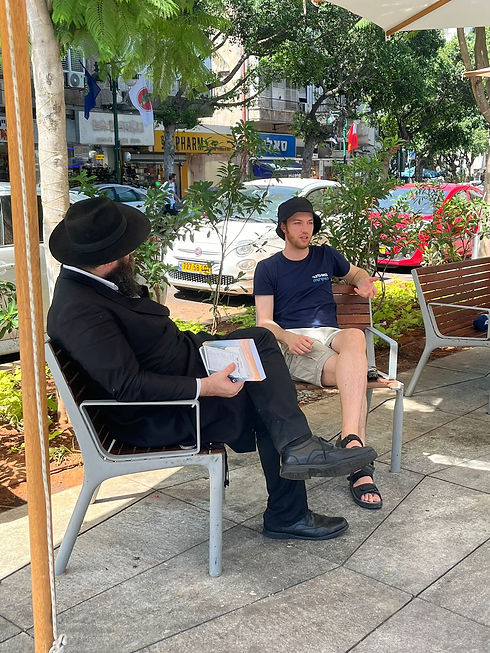
Why on the street?
Face to Face: Breaking Down the Walls Between "Us" and "Them"
Our stalls are usually located in shopping centers, and each stall has about four volunteers.
-
כי המטרה של "בואונדבר" היא להיות ההיפך המוחלט ממה שקורה כרגע בתקשורת או ברשתות החברתיות. ברחוב אפשר לעמוד, פנים אל פנים, ולנהל שיחה בלתי אמצעית - לא בין שני "מחנות" אלא בין שני אנשים.
-
כי הרחוב נותן לנו הזדמנות ליזום שיחה עם כולם, ולא רק עם מי שכבר מתעניין ומחפש מקום לנהל בו שיחה.
-
כי גישת הדוכנים מאפשרת לנו עוד דבר מאוד, מאוד חשוב – להגיע שוב ושוב לאותם מקומות, לדבר יותר מפעם אחת עם אותם האנשים, ולהפוך לחלק קבוע מהמרחב הציבורי.
מה קורה כשמגיעים שוב ושוב לאותו מקום ומדברים עם אותם אנשים? את מי מופגשים רק ברחוב ולמה דווקא איתם ממש חשוב לדבר?
So what do we do?
Talking
About life. About work and children. About the cost of living and the husband in the reserves. About religion, faith, tradition and morality. About the anger, insults and fears that color how we perceive each other. And in general - about how we experienced the past, what preoccupies us in the present and what our hopes are for the future. Israel is currently divided into groups, which know almost nothing about each other. What they don't know, they supplement with assumptions, stereotypes and images from the media. At the stand we discover that reality is much more diverse and complex than what we see in the media, and our interlocutors discover that we also do not match the image that they brought to the conversation. Conversations about personal life help to refute prejudices - on both sides. They also build a platform of familiarity, goodwill, and trust, which allows each of the interlocutors to later talk about charged issues without feeling that their opinions, feelings, and identity are a threatened fortress that must be protected from the other interlocutor at all costs. Why is it important to talk at the podium not only about politics, but also about each other?
Listening
To build the foundation for a real conversation, you first need to listen.
Many people are currently walking around with the feeling that other people "don't count" them - that their needs, opinions, and feelings are not interesting or important - in the eyes of the government, and in the eyes of other groups in Israeli society.
Boundaver volunteers challenge this feeling by first asking people about themselves. We ask people: "What do you think/feel about the situation in Israel?" "What is important to you? What worries you? What gives you hope?"
So we first listen to the answer, and on that basis, develop a conversation.
How do you talk about democracy on the street?
And what does a conversation about democracy look like?
When each side in a conversation feels that its voice will be heard and that the other side respects it and recognizes the legitimacy of its positions, it is possible to talk about all kinds of issues that greatly affect the functioning of democracy in Israel. One of the goals of our conversations is to challenge the boundaries of Israeli identity politics and encourage us all to think differently about where we draw the lines between “us” and “them.” These divisions significantly affect the decisions people make at the ballot box, as well as the distribution of political power in Israel. And perhaps more importantly, they also affect the resilience and cohesion of Israeli society. Another goal of ours during the conversations is to ask questions that challenge implicit assumptions and encourage our interlocutors to stop and think about what they are saying and thinking, and the thought process that led them to think and say it. We ask questions like: Is “unity” the same as “uniformity”? What exactly do we mean when we say “right” and “left”? What even is “democracy”? What does this term encompass? What are its components and why are they important? How do they connect to our daily lives here in Israel and the future we want to have here? What should our expectations be of our government? Of our elected officials? And of ourselves as citizens? How
Democracy is first and foremost a conversation.
Democracy is a way of leading a life together, and to do that, we need conversations. Conversations are the means at our disposal to set priorities, find solutions, and reach agreements. When a candidate wants to run for public office, he needs to talk to the public, in home circles, street meetings, and more. This is a conversation. When an activist wants to change something in a space, renovate a playground, promote an initiative for a public pool in her community, she needs to convince more people to support the initiative so that together they can convince the local authority that it is a worthy cause to invest in. This is also a conversation. When a public official expresses himself inappropriately, and a public outcry arises against him - this is also a conversation. Conversation is also an important tool for dealing with disputes and social challenges. In Israel, we have no shortage of such, so it is a tool that we must practice using.
The founding principles of the State of Israel are two:
Our expectations as citizens from a democratic government are threefold:
The government is subject to the law, and can only enact laws within the framework of the fundamental principles The government must act with professionalism, transparency, and honesty for the benefit of the entire public The government is subject to independent oversight to ensure that it acts according to the fundamental principles In order to implement democratic government, we as citizens are required to create a broad and vigilant civil partnership. We must insist on and monitor the implementation of the fundamental principles and the conduct of government. It is important that we all support elected officials - from all sides of the political spectrum - who will commit to promoting and protecting democratic government. This shared commitment can form a basis that will allow elected officials to work together to implement policy even when they represent very different social, economic, or security positions. Yes, we know, to date the State of Israel has not really adhered to any of this. The truth is that there is much to fix. But the fix is possible - and only together can we build a new public agenda here.
ישראל היא הבית הלאומי של העם היהודי בישראל ובתפוצות. לכל מי שחי במדינה מובטחים חופש, שוויון וקיום בכבוד. שנה וחצי של שיחות ברחוב לימדה אותנו שעל העקרונות האלו יש בישראל הסכמה מאוד, מאוד רחבה.
So join us! Embrace the mission!
